The AI bubble 2026 is the most searched investing topic of the year — searches for “AI bubble” are up 1,581% year over year. People are scared. And honestly, they should at least be paying attention. But before you panic-sell your ETFs or make any big moves, let me walk you through what’s actually happening and what it means for regular investors like us.
So Is the AI Bubble Actually Bursting?
Short answer: nobody knows. And anyone who tells you they do is lying.
What we do know is that the warnings are piling up from people who aren’t usually alarmist. Ray Dalio — founder of Bridgewater Associates, one of the world’s most successful hedge funds — said in January 2026 that AI is in “the early stages of a bubble.” Michael Burry, the guy who predicted the 2008 financial crisis, told his 200,000+ Substack subscribers in May 2026 that “the market has jumped the shark.” He didn’t just say it — he backed it up with a significant leveraged short position against SOXX, the semiconductor ETF that tracks chipmakers like Nvidia and AMD.
And in Deutsche Bank’s 2026 annual risk survey, 57% of investors named a tech bubble as one of their three biggest risks for the year. That’s a record-breaking figure.
But here’s the thing — a bubble forming and a bubble bursting are two completely different events. You can be in a bubble for years before it pops. Or it might not pop at all. Ray Dalio himself stressed that distinction. So let’s look at both sides honestly before deciding what to do.
The Number That Should Worry Every Index Fund Investor
This is the part most beginner investors completely miss — and it genuinely matters.
If you own VOO, VTI, or QQQ — which most people reading this probably do — you already have massive AI exposure. AI-exposed mega-caps represent approximately 40-45% of the entire S&P 500 market cap as of April 2026. Nvidia alone makes up more than 8% of the S&P 500’s index weight. So when you buy a supposedly “diversified” index fund, you’re putting nearly half your money into companies whose fortunes are tied to one single technological thesis.
Here’s the stat that really puts it in perspective. From May 2024 to June 2026, the S&P 500 gained 142%. Take out the AI stocks? That number collapses to just 16%.
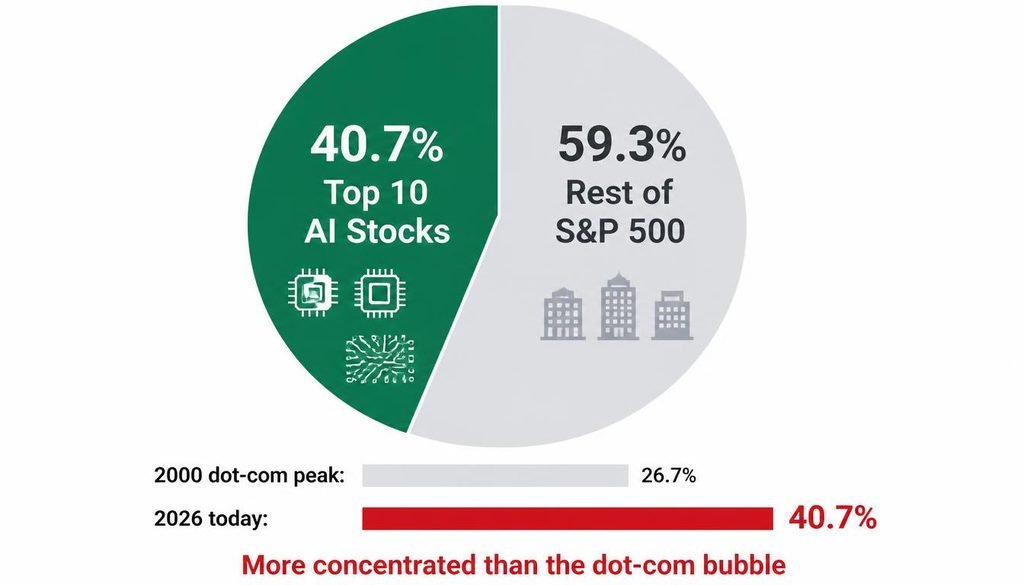
And historically, this level of concentration is unprecedented. The top 10 stocks in the S&P 500 hovered around 18-23% of the index between 1990 and 2015. Today they represent 40.7% — that’s 14 percentage points higher than at the peak of the dot-com bubble in 2000.
We’re more concentrated right now than we were right before the dot-com crash. That’s worth pausing on.
You can research individual stocks driving this concentration — like Nvidia (NVDA) and other AI leaders — in our stock directory to understand exactly what you’re exposed to.
The Bull Case — Why the AI Bubble Might Not Burst
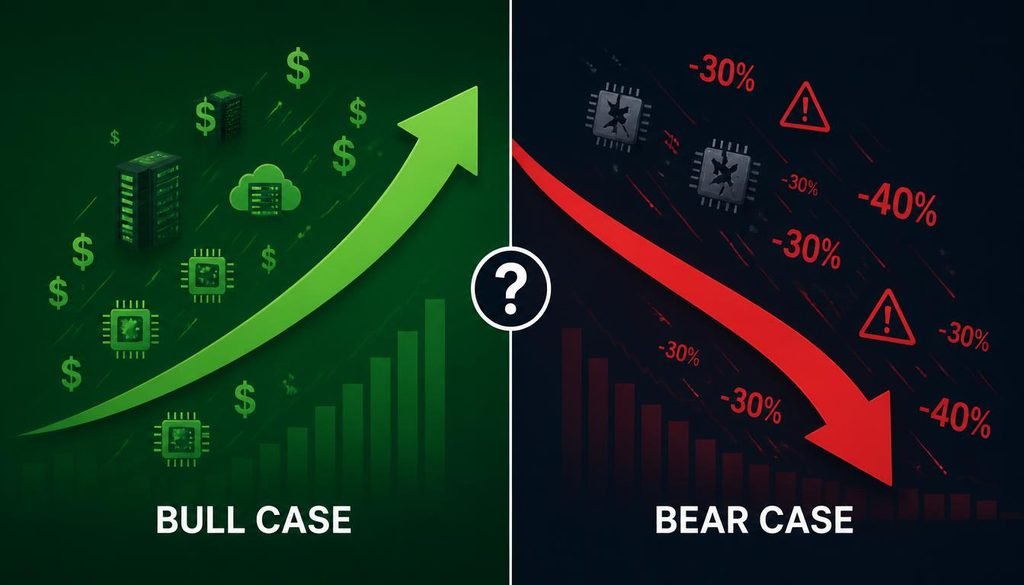
To be fair, there are genuinely strong arguments on the other side. And I’d be doing you a disservice if I only presented the scary stuff.
AI spending is projected to surpass $2.5 trillion in 2026 — a 44% increase year over year. That’s not speculation. That’s capital being deployed right now by the biggest companies on earth. Hyperscaler CapEx — the money Google, Microsoft, Amazon, and Meta are spending on data centers — is accelerating, with $1.25 trillion in AI datacenter spend expected next year alone.
And the companies actually building this infrastructure are making real money. Micron Technology just reported record quarterly revenue of $23.9 billion — nearly triple what it was a year earlier — driven entirely by AI memory chip demand. That’s not a bubble story. That’s a real business.
Goldman Sachs and JPMorgan both argue the growth is fundamentally justified. Their view: AI is a genuine productivity revolution, the companies enabling it are profitable, and the spending cycle isn’t slowing down anytime soon. They’ve got a point.
The Bear Case — Why Smart Money Is Scared
But here’s where it gets uncomfortable.
Man Group — the world’s largest publicly traded hedge fund — published a paper that reads like, in their own words, “a flashing warning sign.” Their conclusion: the AI boom is real, but the financial structure built around it is expanding more quickly than any credible adoption curve can justify.
We’ve seen this exact pattern before. Cisco and Lucent extended billions in financing to customers who couldn’t pay during the dot-com era. The 2008 crisis happened because banks overleveraged on mortgage debt. The mechanism is always the same — real technology, real growth, but valuations that run so far ahead of reality that a correction becomes inevitable when something finally snaps.
Right now, Nvidia and Broadcom are trading at price-to-sales ratios above 30x. Those are levels that have historically often preceded sharp corrections. And in June 2026, we got a preview of what that looks like — AI stocks shed hundreds of billions of dollars in value in a single session after a stronger-than-expected jobs report rekindled fears of Federal Reserve rate hikes.
One jobs report. Hundreds of billions. Gone in a single day. That’s how fragile sentiment is right now.
What This Means for Your ETFs
If You Own QQQ or VTI, You’re Already Deep in AI
This is the point I want you to really understand before making any decisions. You don’t need to buy a dedicated AI ETF to have significant AI exposure. If you own QQQ, roughly 40-45% of your money is already in AI-linked companies. Even VTI — which holds the entire US stock market — is heavily skewed toward these mega-caps because it weights by market cap.
So before you think about “adding AI exposure,” first figure out how much you already have. Most people are genuinely shocked when they do this math.
Dedicated AI ETFs — What’s Actually Inside Them
The AI ETF space has exploded, and performance varies wildly depending on which layer of AI a fund focuses on.
CHAT ETF — which requires companies to derive at least 50% of revenue from generative AI — returned +77% over the past year, making it the best-performing AI ETF. AIQ, the largest dedicated AI ETF with $7.41 billion in assets, returned +29.25% over the same period but charges a 0.68% annual expense ratio. If you want semiconductor exposure specifically, SOXX is the cheapest option at 0.34% with $21.7 billion in assets.
But here’s the catch most people miss — broad AI ETFs like AIQ have 60-70% overlap with QQQ. If you already own QQQ, buying AIQ means you’re largely paying a higher fee to own the same stocks twice. Always check overlap before buying a new ETF.
The 25% Rule
Add up every ETF, fund, and individual stock you own with significant AI or semiconductor weighting. If that total exceeds 25-30% of your portfolio, you’re carrying concentrated risk that most investors seriously underestimate. This isn’t about being anti-AI. It’s about understanding that “diversified index fund” genuinely doesn’t mean what it used to.
What I’d Actually Do Right Now
Here’s my honest take — not financial advice, just how I’m thinking about this personally.
I wouldn’t panic-sell anything. Selling after a huge run-up to avoid a bubble that may or may not burst is a great way to miss further gains while guaranteeing you pay taxes on everything. But I also wouldn’t be aggressively adding to AI-heavy positions at current valuations.
What I would do is check my actual AI exposure across all holdings. Most people have no idea how concentrated they are until they sit down and actually calculate it. Use our investment calculator to model what a 30-40% portfolio drawdown would look like on your current balance — because that’s the realistic downside scenario if the bear case plays out.
If your AI exposure is above 30%, consider gradually rebalancing into assets that don’t move with the AI trade. Dividend ETFs, international ETFs with less AI concentration, or bond ETFs are all reasonable places to park capital that’s currently overweight tech.
And if you’re just starting out and want to actually invest rather than just worry about bubbles — XM is a regulated broker that accepts investors from Pakistan and most countries, with accounts starting from just $5. You can access ETFs, stocks, and other instruments all in one place.
FAQ
- Is it too late to buy AI ETFs?
It depends entirely on your time horizon and your existing exposure. If you have zero AI exposure and a 10+ year investing horizon, adding a small position in something like AIQ or SOXX isn’t unreasonable. But if you already own QQQ or VTI, you almost certainly have more AI exposure than you realize — check that math first before adding more.
- Should I sell my QQQ if I’m worried about the AI bubble?
Probably not all of it. QQQ has delivered extraordinary long-term returns, and timing a bubble exit correctly is notoriously difficult — even Burry and Dalio can be early by years. A more measured approach is trimming QQQ’s share of your overall portfolio if it’s become outsized, rather than making an all-or-nothing decision.
Ironically, VOO or VTI — the broad index funds you probably already own. You get AI exposure proportional to its actual economic weight, without paying extra fees for a dedicated AI ETF. As AI’s share of the economy grows, your exposure grows with it automatically. If AI shrinks, so does your exposure. Built-in rebalancing with zero effort.
- Is the AI bubble in 2026 worse than the dot-com bubble?
In terms of market concentration, yes — the numbers are actually more extreme than at the dot-com peak. But the underlying businesses are far more profitable. Dot-com companies had little or no revenue. Today’s AI infrastructure companies have real earnings and growing cash flows. Whether that justifies current valuations at 30x price-to-sales is the multi-trillion dollar question that nobody — including Ray Dalio and Goldman Sachs — can answer with certainty.
Ready to see what a 30% correction would actually do to your portfolio? Run the numbers with our investment calculator and decide how much AI bubble risk you’re comfortable carrying. Knowledge is the best hedge.