This is probably the most common investing debate on the internet. Both are Vanguard. Both cost 0.03%. Both are excellent. But they’re not identical. Let me break down the actual differences so you can stop overthinking it.
The Core Difference in 30 Seconds
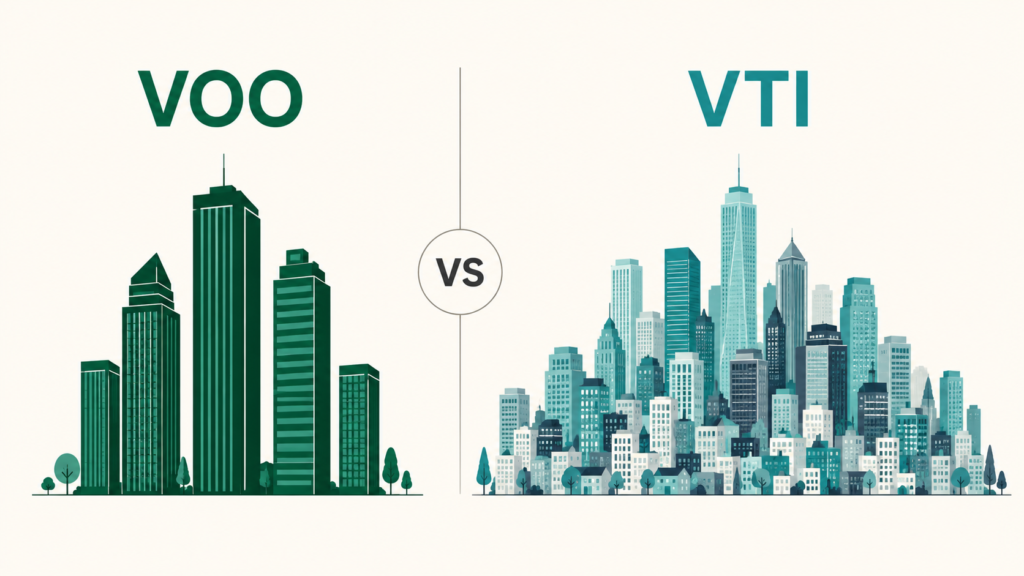
VOO holds the 500 largest US companies (the S&P 500). VTI holds essentially every US company — about 3,600 stocks, including all 500 that are in VOO plus roughly 3,100 small and mid-cap companies.
Think of it this way: VOO is the varsity team (big companies only). VTI is the entire school (everyone from freshmen to seniors). The varsity players dominate either way — the question is whether having the other 3,100 students around makes a meaningful difference.
Side-by-Side Comparison
| Feature | VOO | VTI |
|---|---|---|
| Index Tracked | S&P 500 | CRSP US Total Market |
| Number of Stocks | ~500 | ~3,600 |
| Expense Ratio | 0.03% | 0.03% |
| Includes Small Caps | No | Yes |
| Dividend Yield | ~1.3% | ~1.3% |
| Top 10 Holdings Weight | ~33% | ~30% |
Performance — Does It Actually Matter?
Here’s the thing nobody wants to hear: the performance difference is almost nothing. Over the last 10 years, VOO and VTI have returned within about 0.1-0.2% of each other annually. On a $10,000 investment over 10 years, that difference is roughly $100-200. Not enough to lose sleep over.
The S&P 500 represents about 80% of the total US stock market by value. So VOO already captures the vast majority of what VTI holds. The extra 3,100 stocks in VTI collectively represent only about 20% of the fund’s weight. Small caps just don’t move the needle much in a market-cap weighted fund.
Run the numbers yourself with our investment calculator — use 10.5% for VOO’s historical average and 10.3% for VTI’s to see how little the gap matters over time.
When VOO Wins
Large-cap dominated markets. When big tech companies like Apple, Microsoft, and Nvidia are leading the market (like most of 2023-2025), VOO slightly outperforms VTI. This is because VTI dilutes those big winners with thousands of smaller companies that aren’t keeping up.
If you want to add small caps separately. Some investors buy VOO for large caps and then add a separate small-cap fund (like VB or IJR) in whatever ratio they want. This gives you more control over your allocation than VTI’s fixed approach.
When VTI Wins
Small-cap rallies. Small companies tend to outperform large companies coming out of recessions. If the market crashes and then recovers, VTI typically bounces back slightly faster because those small companies have more room to grow. This happened after the 2020 crash and after 2008-2009.
True set-and-forget simplicity. VTI literally gives you the entire US stock market. There’s no question about whether you’re missing out on small caps, mid caps, or any segment. You own everything. For people who want maximum simplicity, VTI is one fund and done.
Slightly more diversification. 3,600 stocks is more diversified than 500. In practice, the difference is marginal since the S&P 500 already covers the vast majority of market value, but if diversification is your religion, VTI is the broader church.
My Verdict
You cannot go wrong with either one. That’s not a cop-out — it’s the truth. The difference between VOO and VTI over a 30-year investing career will likely be less than the cost of one nice dinner.
If you forced me to pick one, I’d lean slightly toward VTI for a single-fund portfolio because you get complete US market coverage with zero gaps. But if you already own VOO, there is absolutely no reason to switch. The switching costs and tax implications would likely exceed any performance difference.
The most important thing is that you pick one and start investing. The VOO-vs-VTI debate has cost more people more money in lost time than the actual performance difference ever will. Stop debating, start investing.
FAQ
Can I hold both VOO and VTI?
You can, but it’s redundant. VTI already contains every stock in VOO. Holding both means you’re just overweighting the S&P 500 slightly. It’s not harmful, but it’s not helpful either.
Which has better tax efficiency?
Both are extremely tax-efficient. Vanguard’s patented ETF structure minimizes capital gains distributions. There’s no meaningful tax difference between them.
Should I pair either with an international fund?
Yes — both are US-only. Adding VXUS (Vanguard Total International Stock ETF) gives you global coverage. A common split is 60-80% VTI or VOO with 20-40% VXUS.
Compare any stocks or ETFs head-to-head with our comparison tool. Or use dollar cost averaging to see how regular contributions grow over time.